
Common Inventory Management Mistakes That Cost Businesses Money
Captverse · September 21, 2026 · 11 min read
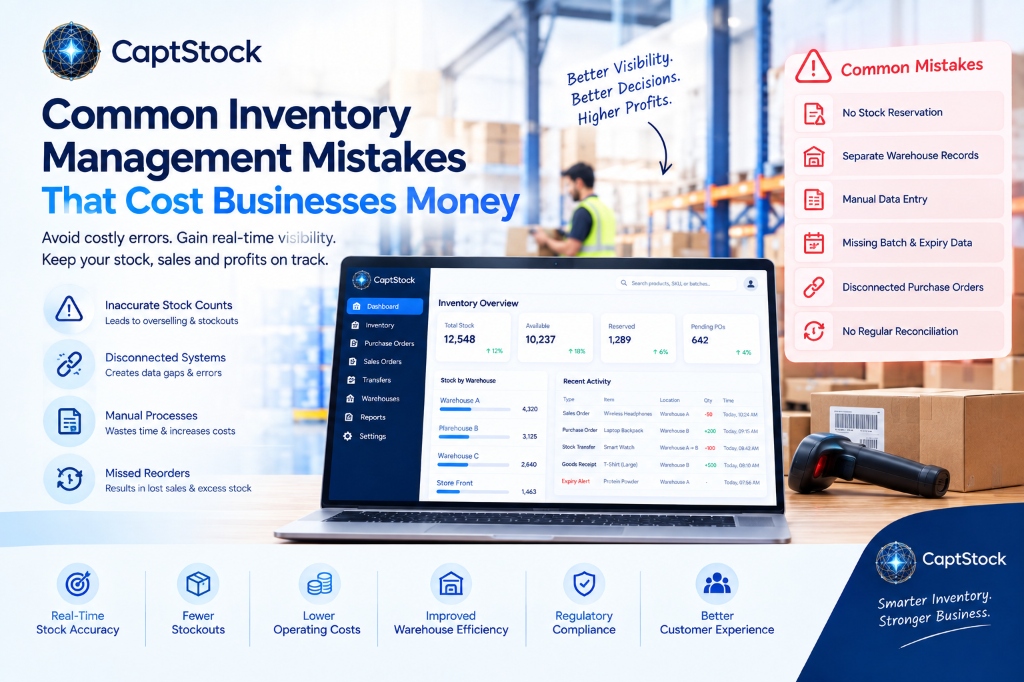
Inventory management mistakes are the recurring errors in how a business tracks, reserves, and moves stock, and they carry a direct financial cost through lost sales, excess stock, and wasted labor. Many of these mistakes are structural, not accidental: they come from disconnected systems, manual data entry, and processes that were never designed for multiple warehouses or sales channels. This article outlines the most common mistakes businesses make in inventory accuracy, stock control, and warehouse efficiency, explains why each one is costly, and sets out practical fixes. It also looks at how connected systems such as CaptStock address several of these mistakes at the source rather than patching them individually.
Key Takeaways
- Inventory management mistakes cost businesses money through lost sales, excess stock, and wasted labor, and most of them are structural rather than accidental.
- Relying on spreadsheets or manual counts as the system of record is the most common root cause of poor inventory accuracy.
- Overselling almost always traces back to one missing step: stock that is not reserved when an order is confirmed.
- Stock control weakens the moment two or more locations are tracked as separate systems instead of one shared record.
- Disconnecting purchase orders from goods receipt causes duplicate reordering and inflated carrying costs.
- Warehouse efficiency improves when businesses fix root causes such as reservation logic and batch tracking, not just add more manual checks.
- Regular stock reconciliation catches small discrepancies before they become expensive write-offs.
What Are the Most Common Inventory Management Mistakes?
The most common inventory management mistakes are relying on manual tracking, failing to reserve stock on order confirmation, treating warehouses as separate systems, losing batch and expiry data, disconnecting purchasing from receiving, and skipping regular reconciliation. Each of these mistakes is common because it is easy to overlook when a business is small and expensive once it grows.
The sections below break down each mistake individually, along with the business impact and a practical fix. Most businesses will recognize more than one of these patterns in their current stock control process.
Mistake 1: Relying on Spreadsheets or Manual Counts as the System of Record
Spreadsheets and manual counts cannot update automatically, so the moment more than one person edits stock data, the numbers start to drift from reality. This is the single biggest driver of poor inventory accuracy in growing businesses.
- Sales and warehouse teams end up working from different, outdated numbers
- Errors compound as more people and locations get added
- Fix: move to a system that updates stock automatically as transactions happen
Mistake 2: Not Reserving Stock When an Order Is Confirmed
Without automatic reservation, two orders can claim the same unit of stock before anyone notices, which leads directly to overselling. This mistake is invisible until a customer is told their order cannot be fulfilled.
- Reservation should happen the moment an order is confirmed, not at shipment
- Cancelled orders should release reserved stock automatically
- Fix: use order software where confirm reserves stock and cancel releases it
Mistake 3: Treating Every Warehouse as a Separate System
When each warehouse keeps its own stock count with no shared record, transfers become hard to trace and stock looks unavailable even when it exists elsewhere. This mistake gets worse with every location a business adds.
- Transfers between warehouses need a tracked workflow, not an informal handoff
- A shared stock view prevents unnecessary reordering when stock exists at another location
- Fix: use one inventory system across all warehouses, not separate local records
Mistake 4: Ignoring Batch and Expiry Data Until It Is Too Late
When batch numbers and expiry dates are recorded as free text or not at all, at-risk stock is often found only when an order is already being prepared. This is a particular risk for pharma, food, and other regulated goods.
- Expiry tracking needs to be structured data, not a note field
- Regular review of at-risk batches prevents last-minute write-offs
- Fix: capture batch and expiry at the point of goods receipt, not after the fact
Mistake 5: Disconnecting Purchase Orders From Actual Stock Receipt
When purchasing and the warehouse use separate tools, stock that has already arrived can go unrecorded, leading to duplicate reorders and inflated carrying costs. This mistake is common in businesses that manage purchase orders by email.
- Goods receipt should post directly against the purchase order that created it
- Purchasing should see current stock levels before placing a new order
- Fix: connect purchase orders, goods receipt, and stock levels in one flow
Mistake 6: Setting Reorder Points by Guesswork Instead of Data
Reordering based on habit or gut feeling instead of actual sales velocity and supplier lead time leads to either stockouts or excess stock sitting in the warehouse. Both outcomes cost money, just in different ways.
- Low-stock thresholds should be based on historical sales data, not fixed guesses
- Lead time from suppliers should factor into when a reorder triggers
- Fix: review and adjust reorder points on a regular schedule using real sales data
Mistake 7: Skipping Regular Stock Reconciliation
Without scheduled reconciliation between system records and physical counts, small discrepancies build up until they surface as a large, hard-to-explain variance. By that point, the root cause is difficult to trace.
- Frequent, smaller reconciliations catch errors while they are still easy to explain
- Reconciliation should be scheduled, not only triggered by a visible problem
- Fix: set a fixed reconciliation cadence and track variance trends over time
Mistake 8: Giving Too Many People Unrestricted Access to Stock Adjustments
When any user can adjust stock counts without a reason or an approval step, it becomes difficult to trace why numbers changed, and shrinkage becomes harder to detect. This mistake usually grows quietly as headcount increases.
- Stock adjustment access should be limited to specific roles
- Every manual adjustment should require a documented reason
- Fix: apply role-based access control to stock adjustments and transfers
Why These Mistakes Cost More as Businesses Scale
Inventory management mistakes cost more as a business scales because each new location, channel, or product line multiplies the number of places where stock data can go wrong. A January 2026 McKinsey analysis of global supply chain leaders found that while 95 percent of companies report visibility into their direct suppliers, only 42 percent can see into the next tier, and that share has declined since 2022 despite years of attention to the issue [1].
The same pattern shows up inside a single company as it grows. A business with one warehouse can often catch a stock error before it reaches a customer. A business with several warehouses and multiple sales channels cannot rely on manual checks, since the same small mistakes now happen in parallel across every location.
The Real Cost of Inventory Management Mistakes
Inventory management mistakes cost businesses money in several distinct ways, not just through lost sales. Understanding each cost category makes it easier to justify fixing the root cause rather than adding another manual workaround.
- Excess carrying cost: stock reordered too early or held too long ties up cash that could be used elsewhere.
- Lost sales from stockouts: orders promised on stock that does not exist cost both the sale and the customer's trust.
- Compliance exposure: missing batch or expiry records create risk during audits or recalls in regulated industries.
- Wasted labor: staff spend hours reconciling numbers between spreadsheets, warehouses, and sales systems.
- Write-offs: expired or obsolete stock discovered too late usually has to be discounted or discarded.
Inventory Accuracy: How to Measure and Improve It
Inventory accuracy is measured by comparing what the system records against what a physical count finds, expressed as a percentage of matching units. A common way to calculate it is dividing the number of accurately counted SKUs by the total SKUs counted.
Improving inventory accuracy usually comes down to fixing the mistakes listed above rather than counting more often. A business that reserves stock automatically, tracks batches at receipt, and reconciles on a fixed schedule will see accuracy improve without adding significant manual effort.
Symptom, Root Cause, and Fix: A Quick Reference
Many inventory problems look different on the surface but share the same underlying cause. This table maps common symptoms to their likely root cause and a practical fix, so teams can diagnose issues faster.
| Symptom | Likely Root Cause | Practical Fix |
|---|---|---|
| Orders confirmed for stock that is not available | No reservation logic when an order is confirmed | Reserve stock automatically on order confirmation |
| Two locations show different stock counts | Warehouses tracked as separate systems | Use one shared, multi-warehouse stock record |
| Expired stock discovered during an order | No batch or expiry tracking at receipt | Capture batch and expiry data on goods receipt |
| Purchasing reorders stock that already arrived | Purchase orders disconnected from stock receipt | Post goods receipt directly against the purchase order |
| Reorder timing feels like guesswork | No data-based reorder points | Set thresholds from actual sales and lead time data |
How to Audit Your Current Stock Control Process
Auditing stock control is a structured review of where data lives, who updates it, and where the numbers stop matching reality. The following steps give a practical starting point for identifying which mistakes are present in a specific business.
- Compare records across systems: Pull current stock counts from every system in use and compare them against each other.
- Check reservation behavior: Check whether confirmed orders reserve stock automatically or rely on manual checks.
- Trace the purchase-to-receipt path: Confirm whether goods receipt updates stock directly from purchase orders.
- Review batch and expiry records: Review whether batch and expiry data is captured consistently at receipt.
- Audit access and adjustment history: Confirm who can adjust stock manually and whether a reason is required.
- Spot-check with a physical count: Run a physical count against system records for a sample of high-value SKUs.
- Document findings and prioritize fixes: List the specific mistakes found and prioritize fixes by financial impact.
Where CaptStock Fits Into This Picture
CaptStock is inventory and warehouse software built to remove several of these mistakes at the source rather than adding more manual checks. It tracks products, warehouses, stock levels, purchase orders, goods receipt, and sales orders in one connected system.
Stock reservation happens automatically when a sales order is confirmed and releases automatically if the order is cancelled, which directly addresses the overselling mistake described above. Purchase orders and goods receipt update stock on hand in one flow, closing the gap between what was ordered and what actually arrived. Batch and expiry data can be captured at receipt, and role-based access limits who can adjust stock or approve transfers.
Warehouse Efficiency Checklist to Avoid These Mistakes
A short, repeatable checklist helps teams catch these mistakes before they turn into costly write-offs or missed orders. Review this list on a regular schedule rather than only after a problem appears.
- Confirm that stock reserves automatically when an order is confirmed
- Check that all warehouses report into one shared stock record
- Verify batch and expiry data is captured at goods receipt, not added later
- Confirm purchase orders post directly to stock on receipt
- Review reorder points against recent sales data at least quarterly
- Reconcile system stock against physical counts on a fixed schedule
- Limit stock adjustment access to specific, accountable roles
FAQ
What is the most common inventory management mistake?
Relying on spreadsheets or manual counts as the system of record is the most common mistake, since it cannot update in real time. Once more than one person or location touches the data, the numbers drift from reality, causing most of the other mistakes on this list.
How does poor inventory accuracy affect a business financially?
Poor inventory accuracy leads to lost sales from stockouts, excess carrying costs from overstocking, wasted staff time on reconciliation, and write-offs from expired or obsolete stock. These costs are often spread across several budget lines, which makes the total impact easy to underestimate.
What causes overselling, and how can it be prevented?
Overselling happens when stock is not reserved at the moment an order is confirmed, allowing two orders to claim the same unit. It is prevented by using order software where confirmation automatically reserves stock and cancellation releases it.
How often should a business reconcile its inventory?
Reconciliation frequency depends on order volume and product risk, but a fixed monthly cycle is a reasonable starting point for most businesses. High-value or fast-moving SKUs often warrant more frequent checks, such as weekly or biweekly.
Can better stock control improve warehouse efficiency without new hires?
Yes. Most of the efficiency lost to inventory mistakes comes from manual reconciliation and correcting avoidable errors, not from a lack of staff. Fixing root causes such as reservation logic and connected purchase orders frees up existing staff time.
Conclusion
Inventory management mistakes are rarely random. They come from specific, identifiable gaps: no reservation logic, disconnected warehouses, missing batch data, and purchase orders that never sync with actual receipt. Each of these gaps has a direct, measurable cost in lost sales, excess stock, and wasted labor.
Fixing these mistakes starts with an honest audit of where the current process breaks down, followed by addressing root causes rather than adding manual workarounds. Connected systems such as CaptStock remove several of these mistakes by design, tying reservation, purchasing, and receiving to one shared stock record instead of several disconnected ones.
References
[1] McKinsey & Company, "Decoding disruption to reshape manufacturing footprints," January 2026. https://www.mckinsey.com/capabilities/operations/our-insights/decoding-disruption-to-reshape-manufacturing-footprints