
Real-Time Inventory Visibility: Why It Matters for Growing Companies
Captverse · September 18, 2026 · 10 min read
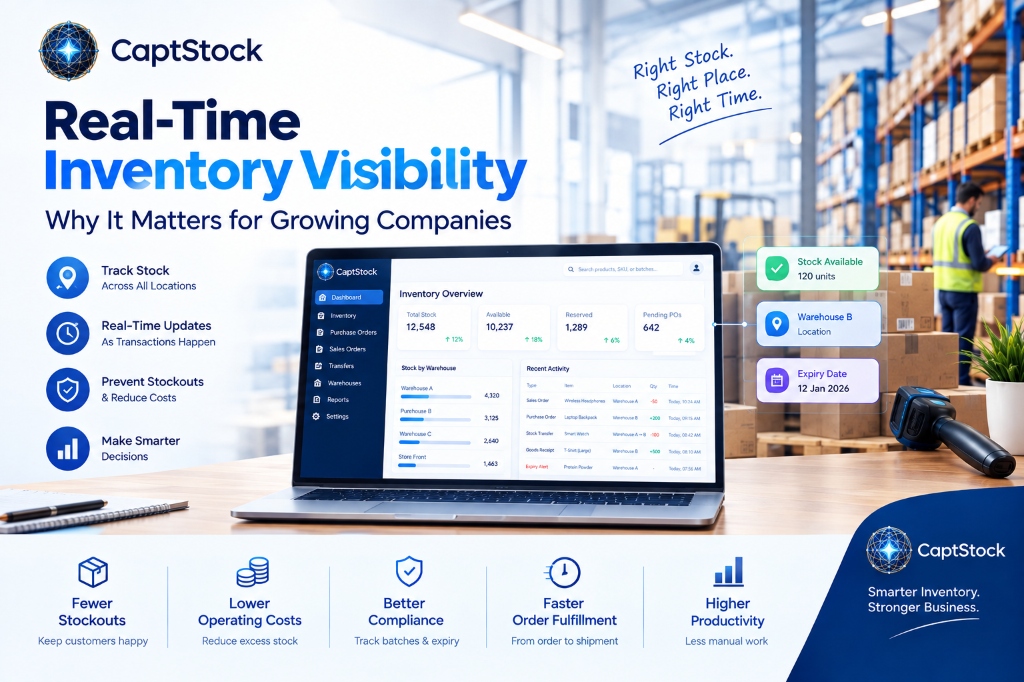
Inventory visibility is the ability to see accurate stock levels, locations, and availability across a business at any given moment. As companies add warehouses, sales channels, and order volume, older methods such as periodic counts and batch-updated systems fall behind actual stock movement. This gap leads to overselling, stockouts, and cash tied up in the wrong products. This article explains what inventory visibility means in practice, why growing companies lose it first, what real-time inventory tracking actually requires, and how connected warehouse operations and systems such as CaptStock help maintain accurate stock visibility as order volume and location count increase.
Key Takeaways
- Inventory visibility means knowing exact stock levels, locations, and availability at any point in time, not just at the last count.
- Growing companies typically lose visibility first, since more locations and channels multiply the places stock data can go stale.
- Real-time inventory tracking means stock records update as transactions happen, rather than on a scheduled batch job or manual count.
- Poor stock visibility leads directly to overselling, missed reorders, and excess safety stock.
- Consistent warehouse operations across warehouses reduces reliance on buffer stock and manual reconciliation.
- Reservation logic (holding stock against a confirmed order) is one of the most direct ways to prevent overselling.
- Software such as CaptStock connects stock, orders, and warehouses in one system so availability reflects what can actually be shipped.
What Is Inventory Visibility?
Inventory visibility is the ability to see accurate, current stock levels, locations, and availability across a business at any given moment. It covers what is physically on hand, what is already reserved against open orders, and what remains genuinely available to sell. Without this visibility, sales, warehouse, and finance teams often work from different, outdated numbers.
Stock visibility is closely related but slightly narrower: it usually refers to knowing where a specific item sits, whether in a warehouse, in transit, or on a shelf. Inventory visibility includes that location data plus the quantity and status behind it. Together, these terms describe the foundation that real-time inventory tracking is built on.
Why Growing Companies Lose Inventory Visibility First
Growing companies lose inventory visibility first because growth multiplies the number of places stock data can go out of date. Adding a second warehouse, a new sales channel, or a wholesale arm all create separate pockets of stock information that stop matching each other.
- A single spreadsheet or manual count works until a second location makes it impossible to keep current.
- In-store, online, and wholesale orders draw from the same stock, but the systems recording them often do not talk to each other.
- Stock moving from a central warehouse to regional branches needs its own tracking, or it becomes invisible in transit.
- As headcount grows, more people update stock manually, and small entry errors compound quickly.
What Real-Time Inventory Visibility Actually Requires
Real-time inventory visibility requires stock records that update the moment a transaction happens, not on a fixed schedule. This means a sale, a transfer, or a goods receipt changes the stock count immediately, and every user across the business sees the same number at the same time.
This differs from batch-updated systems, where stock data syncs every few hours or once a day. A daily sync is often good enough for a single-location retailer with slow-moving stock. It is not good enough for a business running multiple warehouses, high order volume, or same-day fulfillment, where a stale number can mean an oversold order within minutes.
Why Inventory Visibility Matters More as Companies Scale
Inventory visibility matters more as companies scale because the cost of not having it grows with order volume and location count. A January 2026 McKinsey analysis of global supply chain leaders found that while 95 percent of companies report visibility into their direct suppliers, only 42 percent can see into the next tier, and that share has declined since 2022 despite years of attention to the issue [1].
The same pattern plays out inside a single business as it scales. A company with one warehouse can often catch stock errors before they affect customers. A company with five warehouses and three sales channels cannot rely on manual checks, since errors surface as oversold orders or missed reorders before anyone notices the underlying gap.
Warehouse Operations Without Visibility: Common Failure Points
Warehouse operations without reliable stock visibility tend to fail in the same few places, regardless of industry. These failure points usually surface first during peak demand or when a new location is added, which is exactly when the business can least afford them.
- Sales confirms an order before checking that the warehouse actually has the stock.
- Stock moving between warehouses is not tracked as a distinct step, so it disappears from both records temporarily.
- Staff record picks and put-aways after the fact, so the system lags actual warehouse activity.
- Batch and expiry dates tracked in separate notes or files, missed until a shipment is already prepared.
- Purchase orders and goods receipt exist outside the stock system, so incoming stock is not visible until someone updates it manually.
Periodic Counts vs Batch Systems vs Real-Time Inventory Visibility
Businesses generally rely on one of three approaches to track stock: periodic manual counts, batch-updated systems that sync on a schedule, and real-time inventory visibility that updates as transactions occur. Each approach carries a different level of risk and effort as order volume grows.
| Criteria | Periodic Manual Counts | Batch-Updated Systems | Real-Time Inventory Visibility |
|---|---|---|---|
| Data freshness | Days to weeks old | Hours old | Updates as transactions happen |
| Risk of overselling | High | Moderate | Low |
| Multi-warehouse accuracy | Difficult to maintain | Improved but delayed | Consistent across locations |
| Effort required | High, manual counts | Moderate, scheduled syncs | Low after setup |
| Best fit | Very small, single-location stock | Mid-size operations with batch jobs | Multi-location, order-heavy businesses |
Business Outcomes of Improved Inventory Visibility
Improved inventory visibility produces measurable outcomes across sales, operations, and finance, not just fewer stockouts. These outcomes compound as a business adds locations and order volume, since each additional warehouse multiplies the value of an accurate, shared stock number.
- Reduced operational cost: less safety stock held as a buffer against uncertain numbers, and fewer emergency reorders.
- Faster order processing: orders confirm and ship without manual stock checks slowing down the warehouse team.
- Improved compliance: batch, lot, and movement records support audits in regulated industries such as pharma and food.
- Lower business risk: fewer oversold orders and fewer shipments delayed by stock the system did not know it had.
- Increased productivity: warehouse and sales staff spend less time reconciling numbers between systems.
- Better customer experience: accurate delivery promises and fewer cancelled or delayed orders at checkout.
Industries Where Inventory Visibility Is Business Critical
Inventory visibility is business critical in any industry where stock moves across multiple locations, channels, or regulatory checkpoints. A few sectors depend on it directly for daily operations, not just cost control.
- Manufacturing: visibility into raw material and work-in-progress stock keeps production lines from stalling.
- Automotive: multi-warehouse parts tracking supports service commitments and repair turnaround times.
- Banking and insurance: banks and insurers with physical branch or claims-processing supplies need accurate stock records for compliance and cost control.
- Healthcare: batch and expiry visibility is required for regulatory compliance and rapid recalls when needed.
- Retail: stock accuracy across stores, warehouses, and online channels prevents overselling during peak demand.
- Government: asset and supply visibility across departments and facilities supports procurement audits.
How to Build Real-Time Inventory Visibility
Building real-time inventory visibility is a structured process, not a single software purchase. The following steps apply whether a business is replacing manual counts or upgrading from a batch-updated system.
- Map current stock data sources: List where stock data currently lives (spreadsheets, POS, separate warehouse logs) and where it goes stale.
- Define what "available" means for the business: Decide which quantity matters most for each team: on-hand, reserved, or available.
- Set reservation rules: Choose whether stock should reserve automatically when an order is confirmed, and when it should release.
- Standardize data entry at the source: Give warehouses a consistent method (barcode scans, mobile confirmation) to record picks and receipts as they happen.
- Connect the buying and selling sides: Bring purchase orders and goods receipt into the same system as sales orders, so incoming and outgoing stock share one record.
- Phase the rollout by location: Roll out to one warehouse first, confirm accuracy, then expand location by location.
- Measure the results: Track stockout rate, oversold orders, and reconciliation time before and after to confirm the gap has closed.
Where CaptStock Fits Into This Picture
CaptStock is warehouse and inventory software built to keep stock visibility accurate as a business adds locations and order volume. It tracks on-hand, reserved, and available quantities per warehouse, so the number sales sees matches what the warehouse can actually ship.
Stock reservation happens automatically when a sales order is confirmed and releases automatically if the order is cancelled, which keeps available stock current without manual checks. Transfers between warehouses move through a tracked workflow (draft, approved, dispatched, received), so stock in transit stays visible instead of disappearing from both locations. Purchase orders and goods receipt update stock on hand directly, closing the gap between what was ordered and what actually arrived.
Best Practices to Maintain Stock Visibility
Software creates the record, but a few operating habits keep that record accurate over time. Businesses that maintain strong stock visibility tend to follow the same short list of practices.
- Reconcile system stock against physical counts on a fixed schedule, not only after a problem appears
- Record picks, receipts, and transfers at the point they happen, not at the end of the day
- Set low-stock thresholds so reordering starts before a stockout, not after
- Review batch and expiry data on a regular cycle to catch at-risk stock early
- Audit transfer records between warehouses monthly to catch discrepancies while they are small
FAQ
What is the difference between inventory visibility and real-time inventory?
Inventory visibility is the broader ability to see accurate stock levels and locations. Real-time inventory refers specifically to stock data that updates the moment a transaction happens, rather than on a schedule. Real-time inventory is one way to achieve strong inventory visibility, but visibility can also come from well-managed batch updates in smaller operations.
How is stock visibility different from inventory accuracy?
Stock visibility means knowing where an item is and how much of it exists right now. Inventory accuracy measures how closely the system's numbers match physical reality. A business can have high visibility (clear, current data) but still have low accuracy if the underlying counts are wrong, which is why regular reconciliation matters.
Do small businesses need real-time inventory visibility?
Not always. A single-location business with low order volume can often manage with daily or weekly updates. Real-time visibility becomes necessary once a business adds a second location, sells through multiple channels, or handles same-day fulfillment, where a stale number can cause an oversold order within minutes.
Can better inventory visibility reduce warehouse operating costs?
Yes, indirectly. Accurate visibility reduces the safety stock businesses hold as a buffer against uncertainty, cuts emergency reordering, and reduces the staff time spent reconciling numbers between systems. These savings usually show up in carrying costs and labor hours rather than as a single line item.
What causes most inventory visibility gaps in warehouse operations?
Disconnected systems cause most visibility gaps: sales, purchasing, and the warehouse each keeping their own records with no shared source of truth. Manual data entry, delayed updates, and stock in transit between locations are the most common specific failure points.
Conclusion
Inventory visibility determines whether a growing business can trust its own stock numbers. As companies add warehouses, channels, and order volume, older methods such as periodic counts and batch updates fall behind actual stock movement, leading to overselling, stockouts, and excess safety stock.
Real-time inventory tracking closes this gap by updating stock as transactions happen, so every team works from the same number. Connected warehouse operations, covering purchase orders, transfers, and sales in one system, make that number reliable across locations. Software such as CaptStock supports this by tying reservation, transfers, and receiving to one live stock record instead of several disconnected ones.
Ready to see what real-time inventory visibility looks like across your warehouses? Book a demo with our team to walk through your current setup and see CaptStock with your own stock data.
References
- McKinsey & Company, Decoding disruption to reshape manufacturing footprints, January 2026.