
Why Sales Teams Lose Deals Without a Structured Pipeline
Captverse · September 4, 2026 · 11 min read
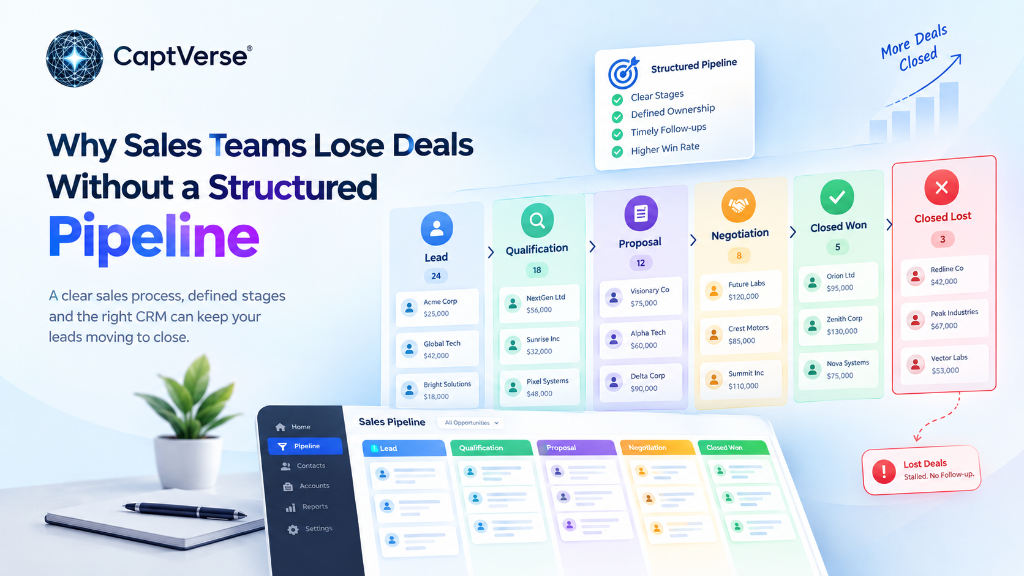
Sales pipeline management is the practice of tracking prospects through defined stages, from first contact to closed deal, so a sales team knows exactly where every opportunity stands and what needs to happen next. Without this structure, deals stall in ambiguous status, follow-ups depend on individual memory, and managers cannot tell which opportunities are actually close to closing.
This gap between having leads and actually converting them explains why many sales teams lose deals despite steady inbound demand. A defined sales process, consistent stage definitions, and a system that enforces follow-up timing address the problem directly. This guide covers why unstructured pipelines lose deals, the stages a pipeline needs, and the practices and tools that keep opportunities moving instead of going quiet.
Key Takeaways
- Sales pipeline management means tracking every prospect through defined stages, not just keeping a list of leads.
- Deals get lost most often at ambiguous stage transitions, where nobody owns the next action or the deadline for it.
- Less than 50 percent of sales leaders and sellers report high confidence in their own forecasting accuracy, according to Gartner, which reflects how common weak pipeline discipline is.
- A structured sales process typically has five to seven defined stages, each with a clear entry and exit criterion.
- Sales pipeline, sales funnel, and lead pipeline describe related but different views of the same underlying process.
- McKinsey research found that B2B sales organizations applying sales-behavior insights to guide rep activity achieved an average productivity improvement of 20 percent.
- A CRM pipeline enforces stage discipline and follow-up timing automatically, reducing reliance on individual reps remembering to act.
- CaptCRM tracks opportunities through configurable pipeline stages with SLA-based follow-up alerts built in.
What Is Sales Pipeline Management?
Sales pipeline management is the process of tracking prospects and deals through a defined set of stages, from initial contact to a closed outcome, so that sales teams and managers can see exactly where each opportunity stands. It replaces informal tracking methods, such as memory, spreadsheets, or personal notes, with a shared, visible system.
The term covers both the structure (the stages themselves) and the discipline of keeping every deal's stage, value, and next action current. A sales pipeline is different from a sales pitch or a sales strategy: it is the operational tracking layer that shows whether the strategy is actually being executed deal by deal.
Why Sales Teams Lose Deals Without a Structured Pipeline
Sales teams lose deals without a structured pipeline because opportunities stall at ambiguous points where no one owns the next action or deadline. When stage definitions are inconsistent or missing entirely, a prospect can sit untouched for weeks before anyone notices the deal has gone cold.
This happens in a few predictable ways. A rep marks a deal as "in progress" with no next step logged, and it quietly ages out of active attention. Multiple reps work the same account without visibility into each other's activity, so follow-ups get duplicated or, more often, skipped entirely because each rep assumes the other handled it.
The business impact compounds over time: a pipeline with no structure cannot produce a reliable forecast, because nobody can say with confidence which deals are truly close to closing. This is not a hypothetical problem. Gartner research found that less than 50 percent of sales leaders and sellers have high confidence in their own forecasting accuracy, a direct consequence of inconsistent pipeline data and process [1].
The Cost of an Unstructured Sales Process
An unstructured sales process costs a business in three concrete ways: lost revenue from deals that stall unnoticed, wasted spend on lead generation that never converts, and unreliable forecasts that lead to bad hiring and budgeting decisions. Each of these compounds the others over a fiscal year.
- Lost revenue: opportunities that go untouched for too long typically choose a competitor who followed up, not because the product was wrong.
- Wasted acquisition spend: marketing and lead generation costs are sunk the moment a lead goes cold from lack of follow-up, regardless of how qualified it was originally.
- Unreliable forecasting: leadership cannot plan hiring, inventory, or budget accurately when pipeline data does not reflect deal reality.
- Rep inconsistency: without shared stage definitions, one rep's "qualified" is another rep's "early interest," and pipeline reports become misleading rollups of incompatible data.
Core Stages of an Effective Sales Pipeline
An effective sales pipeline typically has five to seven stages, each with a clear entry and exit condition, so a deal only advances when specific criteria are met. The exact stages vary by business, but most B2B pipelines follow this general sequence.
- Inquiry or lead capture: a prospect submits interest through a web form, call, referral, or walk-in, and enters the pipeline as a new, unqualified record.
- Qualification: the rep confirms budget, authority, need, and timeline, and the deal only moves forward if it meets a defined bar.
- Proposal or quote: the rep sends pricing or a formal proposal, and the deal now has a specific value attached to it.
- Negotiation: the prospect and rep work through terms, objections, or approvals, typically the stage with the most stalled deals if not actively managed.
- Closed won or closed lost: the deal resolves, and closed-lost reasons get logged so the pattern can inform future qualification.
Sales Pipeline vs. Sales Funnel vs. Lead Pipeline: What Is the Difference?
A sales pipeline, a sales funnel, and a lead pipeline describe overlapping but distinct views of the same sales process, and mixing them up leads to confused reporting. The table below clarifies each term.
| Term | What It Measures | Primary Audience |
|---|---|---|
| Sales pipeline | Individual deals moving through defined stages, tracked by value and owner | Sales reps and managers |
| Sales funnel | Aggregate conversion rate at each stage, viewed as a volume metric | Marketing and revenue leadership |
| Lead pipeline | Unqualified and early-stage leads before they become tracked opportunities | SDRs and lead-generation teams |
Signs Your Sales Pipeline Needs Structure
A handful of recurring symptoms indicate that a sales pipeline lacks the structure needed to prevent lost deals. Recognizing these early is cheaper than diagnosing a missed quarter after the fact.
- Deals sit in the same stage for weeks with no logged next action or follow-up date.
- Different reps use stage names inconsistently, so pipeline reports require manual interpretation before anyone trusts them.
- Forecast calls regularly include deals that "just fell through" with no earlier warning sign.
- Follow-up timing depends entirely on individual reps remembering, with no system-enforced reminder or deadline.
- Managers cannot answer "how many qualified deals do we have this month" without exporting data to a spreadsheet first.
How a CRM Pipeline Fixes Lost-Deal Problems
A CRM pipeline fixes lost-deal problems by enforcing stage discipline and follow-up timing automatically, rather than depending on individual reps to remember. When a deal has been in a stage past a defined threshold, the system flags it instead of relying on a manager noticing during a weekly review.
This shift from memory-dependent tracking to system-enforced tracking has a measurable effect on output. McKinsey research on B2B sales organizations found that companies applying sales-behavior insights, the kind of structured data a CRM pipeline produces, to guide rep activity achieved an average productivity improvement of 20 percent [2].
The mechanism is straightforward: a CRM pipeline gives every deal a visible owner, stage, and next action, and it surfaces deals that have gone quiet before they become a lost-deal statistic in the quarterly review.
Best Practices for Sales Pipeline Management
Sales pipeline management improves when a small number of consistent habits are enforced across the whole team, not left to individual preference. The following practices apply regardless of company size or industry.
- Define entry and exit criteria for every stage in writing, so "qualified" means the same thing across every rep.
- Require a logged next action and date on every open deal, not just a stage label.
- Set a maximum time-in-stage threshold and flag deals that exceed it automatically.
- Review pipeline health weekly, separate from forecast or quota conversations, so stalled deals get attention before quarter-end.
- Log closed-lost reasons consistently, so qualification criteria can improve based on real patterns, not guesswork.
- Keep the number of pipeline stages between five and seven; too many stages slows data entry, too few hides where deals actually stall.
How to Build a Structured Sales Pipeline: Step-by-Step
Building a structured sales pipeline follows a repeatable sequence, whether starting from scratch or fixing an unstructured process already in use. These steps apply to any team size.
- Map your actual sales process as it happens today, including the informal steps reps already follow but nobody has written down.
- Define each stage's entry and exit criteria explicitly, so stage assignment does not depend on individual judgment.
- Set a maximum time-in-stage for each stage, based on your typical sales cycle length, and decide what happens when a deal exceeds it.
- Configure the pipeline in your CRM platform, including automated stage-aging alerts and required fields at each stage.
- Train the team on the new stage definitions specifically, not just on how to click through the software.
- Review pipeline data after 30 days and adjust stage thresholds or definitions based on where deals are actually stalling.
Industry Examples of Sales Pipeline Structure
The value of a structured sales pipeline shows up differently depending on deal complexity and sales cycle length across industries. The following examples illustrate how the same principles apply in different contexts.
- Manufacturing: distributor quotes stall for weeks without a defined follow-up stage, so time-in-stage alerts matter more than lead volume.
- Automotive: trade-in and financing negotiations are the highest-risk stage for stalling, requiring explicit ownership during that step.
- Banking: relationship managers juggle multiple product lines per client, so pipeline stages need to separate cross-sell opportunities from new-client deals.
- Insurance: renewal pipelines require different stage definitions than new-business pipelines, since the trigger events differ.
- Healthcare: procurement cycles are long, making a defined negotiation stage with logged next actions essential to avoid deals going dormant.
- Retail: B2B wholesale pipelines benefit from stock-aware quoting stages, so a deal does not stall waiting on availability confirmation.
- Government: procurement stages often require compliance checkpoints as formal pipeline stages, not informal side steps.
Where CaptCRM Fits Into Pipeline Structure
The stage discipline and follow-up enforcement described above are the specific capabilities most businesses look for when evaluating a CRM pipeline. CaptCRM tracks opportunities through configurable pipeline stages on a visual board, with SLA policies that flag deals at risk of missing a follow-up deadline before they go cold.
It also links pipeline data to the same customer record used by service and quoting, so a stalled deal is visible to a manager without needing to cross-reference separate systems. For sales teams evaluating a CRM pipeline specifically to reduce lost deals, testing stage configuration and SLA alerts against a real pipeline during a demo is the most direct way to judge fit.
FAQ
How many stages should a sales pipeline have?
Most B2B sales pipelines work best with five to seven stages. Fewer stages hide where deals actually stall, while more than seven slows down data entry and makes reps less likely to keep records current.
What is the most common reason deals stall in a pipeline?
Deals most often stall at ambiguous stage transitions where no one owns the next action or deadline. This usually reflects missing stage definitions or a lack of system-enforced follow-up, not a problem with the prospect.
Is a spreadsheet enough for sales pipeline management?
Spreadsheets work for very small teams with few deals, but they break down once multiple reps are involved, since they cannot enforce follow-up deadlines or flag stalled deals automatically. A CRM pipeline becomes necessary as deal volume grows.
How is a sales pipeline different from a sales funnel?
A sales pipeline tracks individual deals by stage and owner, while a sales funnel measures aggregate conversion rates at each stage as a volume metric. Sales teams use pipelines day to day; marketing and leadership use funnels for trend reporting.
How often should pipeline data be reviewed?
Weekly reviews, separate from forecast calls, catch stalled deals before they become quarter-end surprises. Waiting until a monthly or quarterly forecast review is usually too late to recover a deal that has gone quiet.
Conclusion
Sales teams lose deals not because prospects lose interest at random, but because unstructured pipelines let opportunities stall at ambiguous points with no owner and no deadline. Defined stages, explicit entry and exit criteria, and enforced follow-up timing address this directly, and the data backs it up: structured, data-driven pipeline management is linked to measurable productivity gains, while weak pipeline discipline is linked to the forecasting confidence problems most sales leaders report.
The fix does not require a complex overhaul. It requires mapping the real sales process, defining stages honestly, and using a system that enforces the discipline reps will not maintain manually on their own. Businesses evaluating a CRM pipeline for this purpose should test stage configuration and SLA alerts against their own deal flow, including with CaptCRM, rather than assuming any platform fits without seeing it against real pipeline data.