
Lead Management Best Practices for Growing Businesses
Captverse · September 11, 2026 · 11 min read
Lead management software is a system that captures, tracks, scores, and routes sales leads from first contact through qualification, so growing businesses do not lose prospects to slow follow-up or scattered records. As a business adds more channels, more reps, and more inbound volume, manual lead tracking through spreadsheets or personal notes breaks down, and leads start slipping through gaps that nobody notices until a deal is already lost.
This guide covers why growing businesses lose leads without a structured system, the core capabilities lead management software provides, and the best practices that keep sales leads moving instead of going cold. It also outlines the lead management process from capture to conversion and the signs that indicate a business has outgrown manual tracking.
Key Takeaways
- Lead management software captures, scores, and routes leads automatically, replacing manual tracking that breaks down as lead volume grows.
- Most lost leads are not lost to competitors; they are lost to slow or missing follow-up inside the business's own process.
- The CRM sales software market, which includes lead management tools, grew 12.2 percent to 25.7 billion US dollars in 2024, according to Gartner.
- Lead management software differs from basic lead tracking mainly in automation: scoring, routing, and follow-up reminders happen without manual intervention.
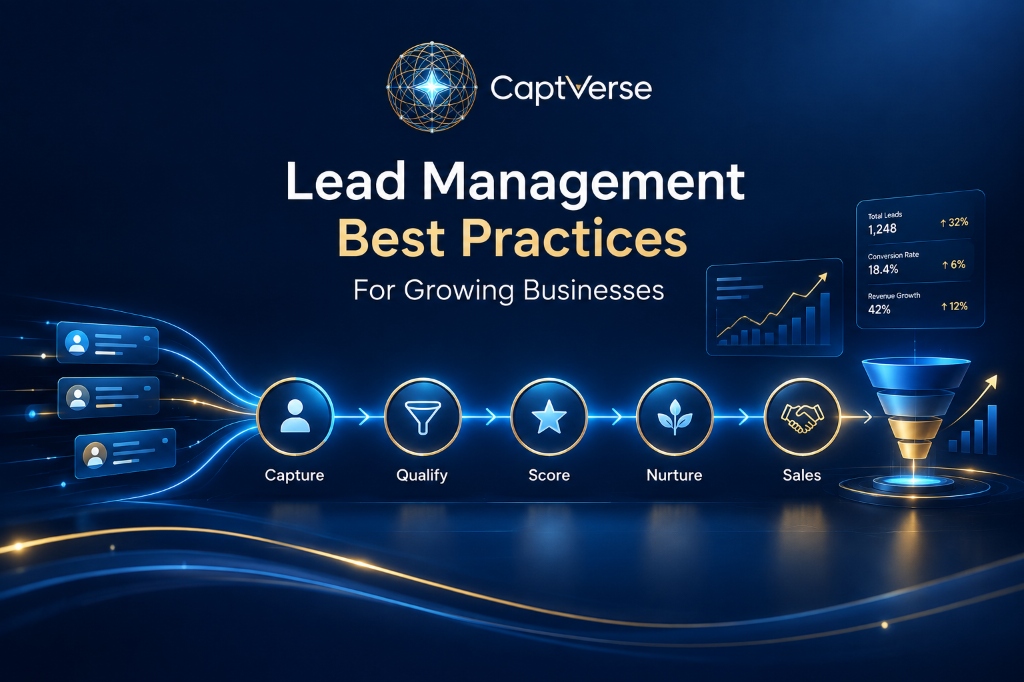
- A defined lead management process has five stages: capture, qualification, scoring, nurturing, and handoff to sales.
- McKinsey research found that sales reps using remote and digital tools can reach four times as many accounts in the same time and generate up to 50 percent more revenue.
- Signs a business has outgrown manual lead tracking include duplicate contact records, missed follow-ups, and no visibility into lead source performance.
- CaptCRM captures leads from web, phone, WhatsApp, and referral sources into one deduplicated pipeline with SLA-based follow-up tracking.
What Is Lead Management Software?
Lead management software is a system that captures incoming sales leads from multiple channels, records their details in one place, scores and qualifies them, and routes them to the right sales rep for follow-up. It replaces manual processes like spreadsheets, sticky notes, or personal email folders with a shared, trackable system.
The core function is preventing information loss as leads move from first contact to a qualified opportunity. Lead tracking, a related but narrower term, usually refers just to recording lead activity; lead management software adds scoring, routing, and automated follow-up on top of that tracking.
Why Growing Businesses Lose Leads Without a System
Growing businesses lose leads without a system because lead volume outpaces what any individual rep or spreadsheet can track reliably. A five-person sales team might manage fine with informal methods, but once inquiries arrive from multiple channels and reps, the same lead can get entered twice, assigned to nobody, or followed up by two different people at once.
This is not usually a competitive loss. Most sales leads that go cold do so because a business's own process let them slip, not because a competitor won them outright. A prospect who fills out a web form and gets no response within a reasonable window typically moves on, and the business never learns why the lead disappeared.
The scale of this problem tracks with how much businesses are investing in fixing it. The CRM sales software market, which includes the lead capture and tracking tools growing businesses rely on, grew 12.2 percent to 25.7 billion US dollars in 2024, reflecting sustained demand for better lead and pipeline visibility [1].
The Business Cost of Poor Lead Tracking
Poor lead tracking costs a growing business in ways that are easy to underestimate because the losses are distributed and rarely show up as a single line item. The impact shows up across acquisition spend, sales productivity, and forecasting accuracy.
- Wasted acquisition cost: marketing spend to generate a lead is sunk the moment that lead goes untracked or unfollowed.
- Duplicate outreach: the same prospect contacted by two reps looks unprofessional and wastes rep time on redundant work.
- No source visibility: without tracking which channel each lead came from, a business cannot tell which marketing spend is actually working.
- Inconsistent qualification: reps apply their own judgment differently, so some genuinely qualified leads get deprioritized while weak ones get chased.
- Slower onboarding for new reps: without a documented lead process, every new hire has to learn tribal knowledge instead of a repeatable system.
Core Capabilities of Lead Management Software
Lead management software typically includes five core capabilities that work together to move a lead from first contact to a qualified handoff. Together they reduce the manual work that causes leads to fall through the cracks.
- Multi-channel capture: pulls leads automatically from web forms, phone calls, WhatsApp, email, and referrals into one system, without manual re-entry.
- Deduplication: matches new leads against existing contacts by phone or email, so the same prospect does not create multiple, disconnected records.
- Lead scoring: ranks leads by fit and engagement, so reps prioritize the prospects most likely to convert instead of working the list in arrival order.
- Automated routing: assigns each lead to a rep or branch based on rules, such as territory or product interest, without manual sorting.
- Follow-up tracking: flags leads that have gone untouched past a defined window, so a manager can intervene before the lead goes cold.
Lead Management Software vs. Basic Lead Tracking: What Is the Difference?
Lead management software and basic lead tracking both record lead information, but lead management software adds automation on top of that record-keeping. The table below outlines the practical differences a growing business will notice.
| Capability | Basic Lead Tracking | Lead Management Software |
|---|---|---|
| Lead capture | Manual entry into a spreadsheet or document | Automatic capture from web, phone, and messaging channels |
| Deduplication | Manual check, prone to error at volume | Automatic matching by phone or email |
| Lead scoring | Not typically available | Rule-based or behavior-based scoring |
| Follow-up reminders | Depends on individual memory or calendar | System-generated alerts on defined timelines |
| Source reporting | Manual export and calculation | Built-in reporting by channel and campaign |
Lead Management Best Practices for Growing Businesses
A small set of consistent practices prevents most of the lead loss described above, regardless of company size or industry. These practices matter more than any single software feature, since even good software fails if the underlying process is inconsistent.
- Capture leads directly into the system at the point of contact, rather than transcribing from notes or messages later.
- Deduplicate by phone number and email before assigning a lead, so no prospect gets contacted by two reps at once.
- Define a maximum first-response window, such as four hours, and track compliance against it.
- Score leads using a small number of clear criteria, such as budget confirmation and timeline, rather than a long checklist reps will skip.
- Route leads by rule, such as territory or product line, instead of manual assignment that slows down under volume.
- Review lead source performance monthly, so marketing spend can shift toward channels that actually convert.
- Log disqualification reasons consistently, so qualification criteria improve based on real patterns over time.
The Lead Management Process: From Capture to Conversion
A structured lead management process moves a prospect through five stages, each with a clear handoff point, from the moment they first show interest to the moment sales takes over a qualified opportunity.
- Capture: the lead enters the system automatically from its source channel, with source and timestamp recorded for later reporting.
- Deduplication: the system checks the new lead against existing contacts by phone and email before creating a new record.
- Scoring: the lead is scored against defined criteria, such as budget, authority, need, and timeline, to indicate readiness.
- Nurturing: leads that are not yet ready receive scheduled follow-up or content, rather than being dropped from the process.
- Handoff to sales: qualified leads are routed to a rep automatically, with full context attached, so the rep is not starting from zero.
How CRM Lead Management Reduces Lost Opportunities
CRM lead management reduces lost opportunities by replacing manual, memory-dependent follow-up with system-enforced tracking and automated routing. When a lead's status, owner, and next action are always visible, it becomes much harder for a prospect to be quietly forgotten.
The efficiency gain compounds with digital tools more broadly. McKinsey research on B2B sales found that reps using remote and digital engagement channels can reach roughly four times as many accounts in the same amount of time and generate up to 50 percent more revenue than those relying on in-person contact alone [2].
For lead management specifically, this translates into reps spending time on qualified conversations instead of manual data entry and lead sorting, which is the core value CRM lead management delivers as a business scales past what informal tracking can handle.
Signs Your Business Has Outgrown Manual Lead Tracking
A handful of recurring symptoms indicate that manual lead tracking is no longer sufficient for a growing business. Recognizing these early avoids losing revenue to a process gap rather than a market problem.
- The same prospect appears as multiple, disconnected records across spreadsheets or inboxes.
- Reps cannot say with confidence how many leads are currently awaiting first contact.
- Marketing cannot report which lead sources actually convert, only how many leads each source generated.
- New reps take weeks to understand the lead process because it exists only as informal, undocumented habit.
- Follow-up timing depends entirely on individual reps remembering, with no system-level reminder or escalation.
Industry Examples of Lead Management in Practice
Lead management challenges show up differently depending on lead volume and sales complexity across industries. The following examples illustrate how the same core practices apply in different business contexts.
- Manufacturing: distributor inquiries arrive through multiple regional contacts, so deduplication by company and phone matters more than lead scoring.
- Automotive: dealership leads from online listings and walk-ins need fast routing, since response speed strongly affects conversion.
- Banking: relationship leads require careful scoring against product fit and compliance criteria before routing to a specialist.
- Insurance: renewal and new-business leads need separate scoring rules, since the qualification signals differ.
- Healthcare: patient inquiry leads require accurate contact capture and consent tracking as part of the qualification stage.
- Retail: wholesale and B2B leads benefit from source tracking tied to specific trade shows or campaigns.
- Government: citizen and vendor inquiries typically need documented routing rules for audit purposes, not just speed.
Where CaptCRM Fits Into Lead Management
The capabilities described above, capture, deduplication, scoring, and routing, are the specific features most growing businesses look for when evaluating lead management software. CaptCRM captures leads from web forms, phone calls, WhatsApp, and referrals into one deduplicated pipeline, with SLA policies that flag leads at risk of missing a follow-up window.
It also connects lead records to the same customer profile used across quoting and support, so a lead's full history stays visible as it becomes an opportunity and later a customer. For businesses evaluating lead management software specifically to reduce lost leads, testing deduplication and routing rules against real lead volume during a demo is the most direct way to judge fit.
FAQ
What is the difference between lead management and lead tracking?
Lead tracking usually means recording lead activity manually, while lead management software adds automated scoring, routing, and follow-up reminders on top of that record-keeping. Growing businesses typically need the automation once lead volume exceeds what a spreadsheet can handle reliably.
When should a business move from spreadsheets to lead management software?
Once duplicate lead records, missed follow-ups, or unclear lead ownership start happening regularly, spreadsheets have stopped being reliable. Businesses handling more than a handful of leads per day across multiple reps usually reach this point quickly.
How does lead scoring actually work?
How does lead scoring work? Lead scoring ranks leads using defined criteria, such as budget confirmation, authority, need, and timeline, so reps can prioritize the most sales-ready prospects first. Scoring rules should stay simple enough that reps apply them consistently.
Can lead management software integrate with WhatsApp and phone leads?
Yes, most modern lead management software captures leads from messaging apps and call systems automatically, not just web forms. Confirm specific channel integrations during evaluation, since coverage varies by vendor.
Does lead management software replace the need for a sales process?
No. Lead management software enforces and automates a process, but the business still needs to define qualification criteria, response time targets, and routing rules. Software without a defined process just automates inconsistency faster.
Conclusion
Growing businesses lose leads primarily to their own process gaps, not to competitors, and the gap widens as lead volume outpaces what manual tracking can reliably handle. Lead management software addresses this directly by automating capture, deduplication, scoring, and follow-up tracking, replacing memory-dependent habits with a system that surfaces stalled leads before they go cold.
The underlying discipline still matters more than any single feature: defined response windows, consistent scoring criteria, and routing rules built around the real sales process. Businesses evaluating lead management software should test these specific capabilities, including with CaptCRM, against their own lead volume and channel mix rather than assuming a generic feature list will fit.
To see how CaptCRM captures, scores, and routes your specific lead sources, book a demo with the CaptCRM team.
References
- Gartner, Market Share Analysis: CRM Sales, Worldwide, 2024.
- McKinsey & Company, The future of B2B sales is hybrid.